"a tour de force"
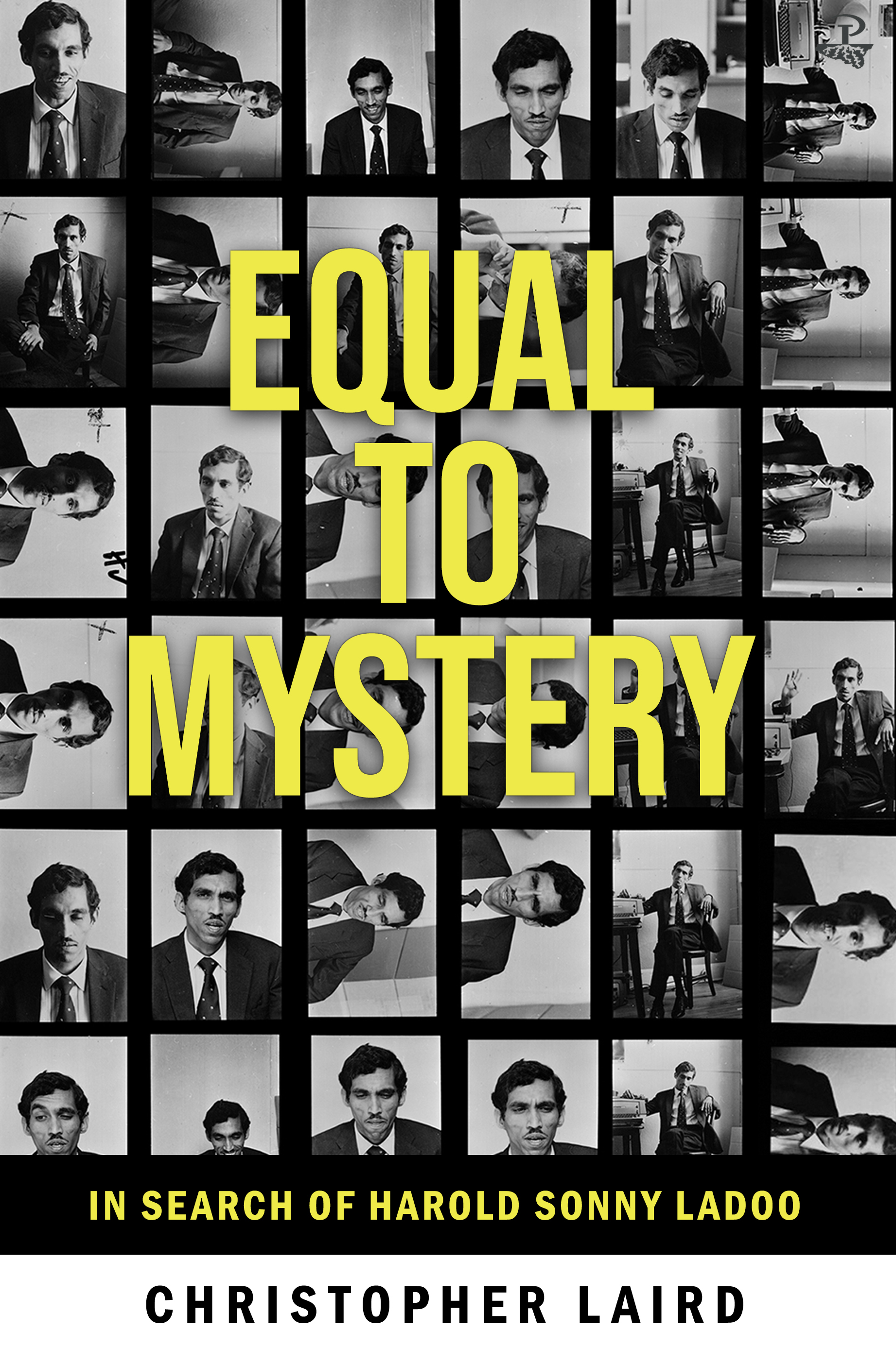
EQUAL TO MYSTERY
IN SEARCH OF HAROLD SONNY LADOO
BY CHRISTOPHER LAIRD
This book begins as a literary detective story and ends as a literary bombshell, challenging the received wisdom of Trinidad’s literary establishment and suggesting new perspectives.
Plain facts: a man is found dead on the edge of a cane-field in Central Trinidad in 1973. He has clearly been murdered, battered to death. In a typical example of Trinidad’s policing tradition, no-one is ever held for the murder. The moving finger writ and having writ moved on… and nobody cares.
Except Christopher Laird, a young film-maker, writer and cultural activist in Trinidad’s capital, Port of Spain. This dead man was a hero to him, the writer of two novels of such radical intensity that Laird had expected him to blaze across the Caribbean literary landscape and rewrite some of the history of the region. Laird was then a cultural ‘young Turk’, publishing a fledgling literary magazine called ‘Kairi’ together with the late poet, Victor Questel. In typical literary magazine tradition, Kairi died in infancy, but not before it had published reviews of two strange books by an unknown writer that had landed across the desk of its editors. That was to launch Laird on his lifework: a search for the author, Harold Sonny Ladoo, the man who had been battered to death on the edge of a cane-field.
‘No pain like this body’, Ladoo’s first novel, was raw, wrenching poetry from the belly of the Trinidadian cane-fields, where first African slaves and then Indian indentured workers were worked to death and degradation by Trinidad’s colonial masters. It was the story many Trinidadians preferred not to see, the contortion of human lives into sheer brutality. Ladoo’s second novel, ‘Yesterdays’, was even more bizarre, a scatological dive into the almost mythological absurdity of life in the sugar producing villages of Trinidad.
Laird’s investigations into the author’s life turned into a journey/obsession that was to last fifty years and take him into the equally bizarre reality of Ladoo’s own character. He interviewed everyone who had ever interacted with the writer, both in Trinidad and in Canada, where Ladoo lived his last years. He discovered that the writer was a will-o-the-wisp who invented and re-invented his own life to suit the people he met, who used and abused, lied, threatened, bullied, charmed and spurned anyone and everyone in the service of a ferocious appetite for attaining his writing ambitions. Ladoo was no child of the cane-fields, as his books suggest, but the son of a wealthy farmer. He was extremely well read in philosophy, history and literature, and wrote with a vision and passion for confronting the most searing aspects of human life. And he created a following among some of the most important Canadian writers of his day.
Laird ransacked heaven and earth to find every scrap of documentation related to Ladoo and discovered beautiful short stories, which he inserted into his biography as evidence of the literary promise that this man represented. Patching this variety of material together was a tour de force that he achieved with the aid of Ladoo’s Canadian mentors. The result is an elegantly written thesis that examines not just this one writer, but the contours of the Trinidadian literary, and even intellectual, tradition.
Niala Maharaj
Text Director
NUMERO NEDERLAND
http://numeromag.nl