By Rory Chisholm (2025)
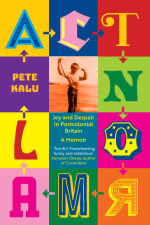
The Joy & Despair of Act Normal Stuart Hall (paraphrasing Benedict Anderson) stated in his essay ‘Whose Heritage? Un-settling ‘The Heritage’, Re-imagining the Post-nation’ that in places like Britain ‘we form an ‘imagined community’ because we share an idea of the nation’ (2023, p. 4). Here include something about Pete (writer/poet published etc…) This concept of the ‘imagined community’ helps us understand the ways in which this community can actually isolate and alienate anyone who does not fit the dominant image of the nation. In his polemic memoir Act Normal: Joy and Despair in Postcolonial Britain (2025), Pete Kalu offers the perspective of being ‘othered’* and the ‘Joy and Despair’ (ibid.) that accompanies the experience of life and childhood in Postcolonial Britain. Kalu is a playwright and has published both poetry and fiction. He was born and raised in Manchester which is the anchor of his memoir; one of the first stories, ‘Pram’, describes being pushed down ‘the high street of Normanville, South Manchester’ (Kalu, 2025, p. 1). The joy and despair being key in describing this work, as though being marketed as ‘polemic’ (HopeRoad, 2025), it is not all seething. The book is prefaced with the statement that it is ‘250 errant mini-essays’ (Kalu, 2025), chiming with its market language as ‘polemic’. Through the rage, moments of bliss peak through: romantic encounters with missing kisses, childhood ramblings with friends, snapshots of feeling about the beauty of inherited features. Kalu has created a tapestry of memories that explore the dichotomies of joy in the small every day, and despair at the structural and interpersonal racism – also of the everyday.
The Oxford English Dictionary defines errant as ‘Erring in opinion, conduct, etc., deviating from the correct standard’ (2025). The key here being ‘deviating from the correct standard’ (ibid.) as Kalu explores the memoir form in a way that is untraditional, in fragmented non-chronological vignettes that allow a reader to enter his narrative at any stage. We see how ‘errant’ (ibid.) not only applies to the tone of the essays but also the form and structure, this form challenges the idea of the ‘correct standard’ (ibid.) of the memoir form but also British politeness. Traditionally, the memoir or biography unfolds chronologically for a reader, balancing a light-hearted tone whilst also having the appropriate amount of life’s trials and tribulations. They tend to spoon-feed a reader with a slice of life that ultimately leaves you feeling empty, the taste of something real swimming in your stomach. British memoirs then, follow this form whilst also maintaining a sense of polite individualism, the struggles the writer faces in their life are often not attributed to anything other than the invisible tugs the universe pulls us through – the ups and downs everyone faces. Kalu subverts this, he errs from the polite mode of thinking and directly challenges the sometimes intangible face of racism. He refuses to be vague, especially in pieces like ‘The problem has always been white people’ (Kalu, 2025, p. 55), where he notes the effort made in making oneself palatable for white people to make life easier and to ‘get that job’ (ibid.). Kalu concludes that Black people can do all this work and it does not matter, as ultimately the decisions are left up to ‘a table of white people who would say yes or no, depending on whether they ate cornflakes or eggs for breakfast’ (ibid.). Furthermore, he deviates in the established tone of a memoirist in that he weaves out of personal exploration and astute observations on race and sexuality within the UK, but mostly his hometown of Manchester. There are more explicit examples of critical theory, like in ‘Afro-pessimism and Black Lives Matter’, where he makes brief reference to *Edward Said states in his book Orientalism (1979) that the Orient is othered by the image of the West. This also applies to the way the Global Majority are marginalised in the UK. Existentialism, the ‘Meaninglessness of Life Itself’ (2025, p, 126) and discusses hopelessness in the face of racism; but there are also essays like ‘Getting your bearings’ (p. 39) which more subtly address the ghosts of colonial past in trying to find your way in a town where there are buildings called the “Black Boy pub” and streets like ‘Plantation Road’ (p. 40). However, this later contested in a similar essay later in the book called ‘Black pessimism: misery walks’ (p. 176). Kalu discusses again ‘the congealed vat of historical misery’ (ibid.) that permeates the monuments and buildings of the UK, from the ‘country home […] Funded by slave money’ to the docks where ‘slave ships pushed off from’ (ibid.). This time he concludes the essay with a more liberating perspective: ‘Adopt a blithe spirit. Black joy requires wilful ignorance’ (ibid.). This obviously has a sheen of irony to it but also has truth to it too. These places are both beautiful and horrific, there is both joy and despair to their existence.
What you come to enjoy and really feel as a reader, however, is the Joy and Despair of its subtitle; the extremes depicted beautifully throughout. Although, selfasserted as mini-essays, some read like poetry. Particularly in the warm simplicity of ‘On eating birthday cake alone’, which, like the others, perfectly encapsulates the extremes of the subtitle. Kalu adopts the unusual second person perspective and describes the quite lonely experience of ‘One winter day’ (p. 50) eating birthday cake alone while in ‘broken shoes’, in a ‘bare flat’ (ibid.), with the lights off, bills stacking up alongside the obituaries of friends. The despair is staring us in the face here, a bitter and lonely image is painted for us, but Kalu tells the reader ‘You will have summers’ (ibid.).This story, and the whole book seem to act as a collage of British postcolonial writing here. The joy of the summer and ‘dancing shoes’ feel reminiscent of the stream-of-consciousness passage in Sam Selvon’s The Lonely Londoners (1956; 2006). The passage neglects punctuation and so-called proper grammar as Selvon describes how ‘making love in the winter you would never think that the grass would ever come green again’ (p. 92-93). The seasons changing, particularly the arrival of summer, act as a reset or a new era, almost biblical. This links directly to the mini-essay, as there is an acceptance that through the tough times, the sun will come: when summer come is fire in the town big times fete like stupidness and you have to keep the blood cool for after all them cold and wet months you like you roaring to go (Selvon, 1956; 2006, p. 93) In Kalu’s essay he details how life will improve and how friends will help you and significantly, ‘how time seasons you’ (Kalu, 2025, p. 50). The language here acts more as poetry, it is beautiful and tugs at your emotions in its purity. It again links back to The Lonely Londoners with ‘they will bring dancing shoes’ (ibid.), this is similar to the ‘fete in St Pancras Hall’ (Selvon, 1956; 2006, p. 104). It’s a comical scene where the character Harris throws a party for where he invites white people and his friends who he tries to get to ‘behave’ (p. 105). Ultimately there is in the scene, both joy and despair, as the boys rile each other up and dance wildly with the white girls. These emotions and complexities exist under and above the skin of Act Normal too, as although it is technically non-fiction, the texts of the Black British past are present in Kalu’s book. ‘One winter day’ (Kalu, 2025, p. 50) may be drawing upon an individual experience, but the positioning of the second person (and it’s similarities to The Lonely Londoners) allows for multiple meanings for a reader. The mini-essay is both life-affirming and a kiss towards the previous writers of the diaspora.
In ‘Stilts and Philosophy’, a story is recounted of being pushed off stilts by a racist and his musings on Sartre’s belief that ‘we emerge from this world from nothingness’ (p. 60) and ultimately ‘roll back into nothingness’. Kalu starts to tread into pessimism, seeing himself as ‘dancing for coins’ and being close to ‘minstrelling”(ibid.), but the resolve resists this temptation of cynicism as he agrees to work another day at the prospect of a bonus and a free donut. This is the core of existentialist philosophy that is sometimes missed, to experience ‘jubilation’ in the midst of all this ‘angst’ (ibid.); to be able to allow yourself to feel the joy even in the face of the despair of racism. Sartre, one of the key philosophers in existentialist thought has a conception of authenticity that ‘rests upon an ethics designed to liberate the individual from living in ‘bad faith’’ (Green, 1990, p. i). What Green means is that the key to freedom is authenticity of the individual, to acknowledge the terror and anxiety of existence and keep persisting despite this. The terror and anxiety of existence encompasses many things, like mortality, but it could encompass the structures of white supremacy and racism. The authenticity in this case is how an individual resists the trappings of these structures, to not fall into turmoil, but actively work towards a liberated existence. Kalu is aware of the nuances of this, in pieces like ‘Black Optimism’ (Kalu, 2025, p. 37), he discusses the difficulty in acknowledging racism and oppression exists, because it means being ‘forced to accept we are dragging around a ball and chain’ (ibid.). Although a believer in existentialism and authenticity as a means to freedom he also states that sometimes ‘Black joy requires wilful ignorance’ (p. 176), that sometimes just to be happy you have to ignore the ball and chain.
This pleasingly links with an earlier story ‘Amen to the fallen: Requiem for the vanguard, for the conk-haired, & for the soft-shoe shufflers’ where Kalu, semiironically, eulogises the ‘soft-shoe shufflers’ (p. 5) or minstrels. He states that ‘This requiem is not a condemnation’ as there exists in Black people ‘a face we fix on for white people’ (ibid.). Here, historical theorists of race and identity are nodded to, particularly the work of Frantz Fanon. In his book, Black Skin, White Masks (1952; 2008) he interrogates the identity and effects of colonisation on Martinicans and how ‘Every colonised people […] finds itself face to face with the language of the civilising nation’ (2008, p, 9). However, his ideas can be applied to modern life as experienced by the global majority in the UK and the way heritage is smothered by the culture of the colonisers. Obviously this is not a celebration of minstrelling, but rather an honest statement on the nuances of race and performance. Again, joy peeks through – there is a humanity that undulates throughout the mini-essays among its honest poetics and critical observations. Kalu acknowledges how contemporary society and Black identity do not always function together in rational ways and therefore life does not operate logically when its far-reaching roots are extending from a large colonial tree.
As Gilroy notes, ‘Racism in Britain has often denied black life here any historical dimension’ (Getty Images, 2007, p. 23), but both Gilroy with Black Britain: A Photographic History (2007) and Kalu with his memoir work against this denial. Throughout the book, aspects of conformity to British society and white supremacy are interrogated – Kalu analyses the narratives imposed upon the global majority in the UK. In ‘Smiler’, facial expressions are deconstructed through race and gender. He states how some young black boys have learnt that the way to align with the expectations of white adults, ‘is to keep smiling’ (2025, p. 35). This again circles back to Fanon’s ideas surrounding racial performance. When discussing Antillean children, Fanon notes how the comics, books and stories that are consumed by them, all result in the ‘crystallization of an attitude and a way of thinking and seeing that are essentially white’ (1952; 2008, p. 114). The culture of the colonisers then, becomes a kind of lens. Black and Antillean identity are more or less erased by the domination of this, as what becomes heralded by the children is whiteness and the white hero. Kalu’s piece addresses how this is continued in Britain, the central mode of politeness shows its aggressive nature that lies under the surface. If Black people err outside of this mode, there is almost a double deviation as white people view them as a threat.
The echoes of Fanon’s voice sound throughout the book, with the ways Kalu addresses postcolonial life in the UK. His book is brimming with these and other echoes, it exists as an intertext* this way. As it is a blend of theory, poetry, and memoir it reveals new layers upon rereading. Two other texts that come to mind are bell hooks’ essay ‘Homeplace: A Place of Resistance’ from Yearning: Race, Gender and Cultural Politics (1990), and Édouard Glissant’s Poetics of Relation (1990; 2025). Both texts reinvent the ways in which traditional theory was written – hooks weaving personal experience with theory, and Glissant weaving philosophy with poetry. hooks’ essay also touches upon joy as an act of rebellion, she describes going to her grandmother’s house (which was in a predominantly white neighbourhood) - ‘this sweetness and the bitterness of that journey, that constant reminder of white power and control’ (1990, p. 54). The joy is found by hooks in the conception of the home, she sees it as a site to resist the thorny branches of white supremacy. She says that it is in the ‘“homeplace,” most often created and kept by black women, that we had the opportunity to grow and develop, to nurture our spirits’ (p. 56). Glissant’s text aligns more with Fanon as he explores French Caribbean identity, not through autoethnography, but through a meshing of poetry and analytical thought. Here Glissant links to Kalu in their shared deflection of the so-called correct standard in literature. Betty Wing (the English translator of the book) states that Glissant even ‘forces new word complexes’ (Translator’s Introduction, 1990; 2025, p. xiii). Both Kalu, Glissant and hooks are errant in their approaches to writing, revealing that, despite their language being printed on the page, it remains alive, breathing, changing.
Some of the book is fictionalised and is written as if Kalu has woken up middream to write down the events. This is how the memoir concludes, with ‘Death goes dancing’ where his father ‘climbs out of his coffin’ (2025, p. 236), parties and dances with the guests of his funeral and ‘A dream as filmscript: Die now, England motherfucker’ (p. 237) which is a comedic dialogue between possibly Pete Kalu and an ‘Assailant’ (ibid.). He circles back to finish with joy and despair mingled in both stories – the juxtaposition of both at a funeral as mourning but also the celebration of life, and the black comedy of British over-politeness when being threatened with violence. Kalu ends with ‘[At this point I wake up.]’ (p. 238) leaving us with the absurdity of life and the happiness found there, that despite all the despair we face, it will end. And the joy will return.
Bibliography
Fanon, F. (1952; 2008) Black Skin, White Masks. Translated from the French by C.L. Markman. London: Pluto
Gilroy, P. and Getty Images, Inc. (2007) Black Britain: A Photographic History. London: Saqi. Glissant, É. (1990; 2025) Poetics of Relation. Translated from the French by B. Wing. London: Penguin.
Green, C.C. (1990) Authentic Existence: Its Individual and Social Dimensions. UBC Retrospective Theses and Dissertations, 1919-2007. Available from: <https://dx.doi.org/10.14288/1.0106779>
Hall, S. (1999) Whose Heritage? Un-settling ‘The Heritage’, Re-imagining the Post-nation. Third Text, 13 (49) Winter, London: Routledge, pp. 3-13.
hooks, b. (1990) Yearning: Race, Gender and Cultural Politics. New York: Routledge. Available from: <https://doi.org/10.4324/9781315743110>.
HopeRoad. (2025) Act Normal by Pete Kalu – The Official Launch. UK: HopeRoad.
Kalu, P. (2025) Act Normal: Joy and Despair in Postcolonial Britain. London: Hope Road.
Oxford English Dictionary (2025) errant, adj. meanings, etymology and more. UK: Oxford English Dictionary. Available from: <https://doi.org/10.1093/OED/5647926872>
Said, E. (1979) Orientalism. New York: Vintage Books. Available from:
<https://search.ebscohost.com/login.aspx?direct=true&scope=site&db=nlebk…; [Accessed 3 December 2025].
Selvon, S. (1956; 2006) The Lonely Londoners. London: Penguin.