


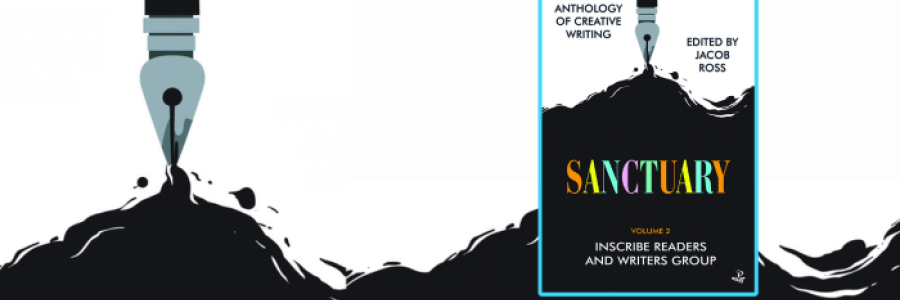
We were really pleased to have a group of Leeds Beckett undergraduate students on placement with us as part of their Black British Lit module. As a part of this module they responded to Sanctuary, and produced a piece of public facing work. Here are some of the excerpts from their responses to Sanctuary.
These responses considered form, the Black History Month 2025 theme ‘Standing Firm in Power and Pride,’ and the Mic Check! event at Leeds Libraries.
About Sanctuary:
Sanctuary is an anthology from Peepal Tree Press’ Leeds-based Inscribe Readers & Writers Group. The diversity of themes and styles is a testament to the remarkable growth of the group over the past two years. Contributors are pushing against the boundaries of the various forms they are engaged with. Their work is no less nuanced and introspective than the previous anthology; if anything, it is more daring and exploratory. A feast of themes, styles, subject matter and insights awaits the reader: from frank and powerfully erotic fantasy to meditative interrogations of the writer’s relationship with the physical spaces they occupy. The group is led by Senior Fiction Editior Jacob Ross. Sanctuary published 31st October 2024.
Student Responses:
'(Home) from (Home)' by Lorraine Dixon - by Aasiya Elias
The piece I would like to put forward is '(Home) from (Home)' by Lorraine Dixon (p.87). I wanted to focus more closely on the Pride part of the theme for BHM, which I think this poem really delicately demonstrates: a pride for the language, food, and agriculture of their home country.
Why I think this piece [email protected] out to me was because of how smoothly she codeswitches - it certainly takes a level of pride to do so - and still the poetic elements remain strong in both dialects and are actually more impactful. The language and imagery in the first line with "flavour-filled promises" is followed by nostalgia in the second line, the nostalgia reflected by the switch.
The focus of the poem is food, and the memory of it, which is what makes up such a large part of any culture. There's pride in the ackee that "nah come outta tin" and her aunty who was expert at cutting fruit and preparing it. I think it's interesting to compare that to the relationship with agriculture we have today in England. The speaker herself mentions walking down aisles of "multi-coloured cans" which is a stark contrast to obtaining produce with care and attention with your own hands, "freeing firm flesh from pod", like her aunty might've done at home.
Nostalgia is what defines this poem, the speaker reminisces with pride and stands firm as even in England, a home from home, they make this same dish, though it's with tinned instead of fresh vegetable. I particularly love the alliteration and flow of the words which, as mentioned, takes a level of pride and skill to do so. The speaker is reminiscing about life in her home country, and she speaks with pride about it as she remembers the beautiful and little details. Remaining firm and strong on their home culture in a different country is shown by the switch between dialects, and the decision to continue making this home-dish, despite the compromise of the fresh ackee.
‘Listen’ by Peter Ejedewe - Serena Ahmed
After reviewing the piece ‘Sanctuary’, an anthology consisted of creative writing that delves into the challenges of identity and acceptance, I was astounded by the way the book both challenges discrimination that often accompanies cultural diversity whilst also celebrating it. I loved how the anthology unites a range of voices whilst embracing heritage yet shedding light on the complexities of exclusion faced.
The piece I was drawn to was ‘Listen’, written by Peter Ejedewe, an English Course Director at Leeds City College, who is of Nigerian and Jamaican descent – the heritage which is heavily reflected in his writing. Ejedewe’s ‘Listen’ strongly evokes the central message of Sanctuary. It delves into the struggle between identity, acceptance and the desire to be heard in a society that frequently supresses diversity. Through the rhythmic tone and immersive imagery, the poem reimagines everyday actions, sounds and stillness into a metaphor for resilience and a community of voice.
At the start of the piece, “Not silent/not quiet/ not absence/not alone,” immediately establishes a stance of defiance. It subverts invisibility and asserts recognition – a declaration of cultural endurance that mirrors the anthology’s focus to celebrate diversity whilst defying the prejudice alongside it. Throughout the piece, Ejedewe uses striking imagery – “crying skies”, “aching hearts” and “lost souls setting “are examples of images that portray collective suffrage and yearning. Yet the direct address to the audience at the conclusion of the poem to “Listen” serves as both an invitation and a plea to demand for justice and action, to honour and acknowledge the narratives, heritage and humanity of those in society who have been silenced. In the context of the event ‘Mic Check’ and the Black History Month 2025 theme, “Standing Firm in Power and Pride”, Ejedewe’s “Listen” holds a particularly significant place as a powerful affirmation of Black voices. Its rhythmic tone and emotive sentiment embody the strength, pride and enforcement that Black voices refuse to be silenced. “Listen” functions as both an embracement of individuality and shared declaration – recognising cultural heritage whilst confronting the pain of isolation. During the “Mic Check”, engagement with the audience allowed spoken word performers to bring a piece of poetry like this to life as a shared experience of attentiveness and empowerment. “Listen” therefore enacts as more than a poem; it transforms into an expression of persistence- claiming power and pride through the unwavering resonance of voice and cultural identity.
'Mardi Gras under the freeway' by Emily Zobel Marshall - Aliza Azfal
This piece of poetry really spoke to me and I feel like I would be very suitable for the event, especially considering this year's theme being 'Standing Firm in Power and Pride'. The poem mentions a 70-year-old woman going out during a parade representing Black British Culture. Within the last paragraph of the poem there are the lines "When Miss Delphine walks home that night, she knows the stars cannot shine brighter than her people". I found these few lines very beautiful when first reading them. They fully express the love and pride she has in her own people. Also, the lines "now she's spinning across hurricane-split paving, is dancing the dance of Black skin worn thin" in a way represent power. Considering she is a 70-year-old lady, she still has the strength to represent her own culture. Even though this poem is quite simple, I do feel it has a lot of meaning to it.
‘Prayer’ by Lara Rose - Harry Ronch
Firstly, I have picked the poem Prayer as it highlights the ancient but constant practice of, often communal, prayer. This relates, to me, to the event itself as the communion found in live music and spaces where people can freely experience and discuss art can serve similar
purposes to the act of prayer illustrated in the poem by bringing disparate people together and creating clarity for people. For artists, I believe working on art is often a religious act in itself, with the continuation of arts essentially acting mentally as a higher power to work towards.
Furthermore, I think the way the poem mentions several Gods from several cultures, as well as in different languages, serves to highlight the point that people across the African diaspora and beyond should not be further dividing themselves but instead recognising the
ways in which they are similar. Mentioning Olodamure, the Yoruba religion’s greatest God, just one line away from Jesus Christ in the same reverent fashion to me illustrates that although different black communities serve different religions, especially across time, the ultimate goal is always one of togetherness and goodness. This relates to the theme of cultural exchange during the event, promoted by the bookswap, in the way that it encourages people to recognise and celebrate their differences but acknowledge that none of these differences prevent us from connecting as people.
Finally, I think that the general theme of prayer is an important one as it encourages people to look towards better times and greater things, a message especially important to the Black British communities that the event highlights. Historically, religion has often been important
for black people in western countries as it presents hope in the face of oppressive circumstances they have often been placed in. While I don’t think encouraging people to turn to religion because of the increased racism in England in the past few years due to
politicians like Nigel Farage is necessary, I think the ultimate message of hope is very necessary indeed. To me this is a beautiful poem that celebrates the togetherness of people not only across cultural borders but also across generations.
‘Protest’ by Rheima Robinson - Coco-Tee Nkala
Protest by Rheima Robinson is a poem I feel would be relevant for this event as it is contemporary and covers topics that adhere to the theme: ‘Standing Firm in Power and Pride’. The poem highlights the gritty truth that surrounds protesting for matters such as race and basic human rights and how it is often met with negativity from law enforcement and spectators who are ignorant and dismissive. This makes the poem educational; it highlights the reality of what it means to fight for what is right for readers and listeners who otherwise would not have a clue. This leads me to believe the target audience for this poem is those people who are otherwise clueless. The poem discusses loss and grief caused by the deaths of black men who have lost their lives to police brutality as in seen in the 3rd stanza. Protest also touches on the importance of not backing down and continuing the fight, regardless of what happens as a result, it is the only way to make a significant change. Attendees of the Mic Check Event would greatly benefit from a poem like this despite it being slightly heavier its important draw attention to one of the main reasons they are there.
Made of Light by Emily Zobel Marshall - Thi Thanh Huyen Nguyen
I chose Emily Zobel Marshall's poem "Made of Light" because it clearly expresses the idea of a "Sanctuary" in a very subtle and emotional way. The poem describes a character swimming in the ocean, detached from "time" and "fear", as if they are stepping out of the pressures of the outside world. The sea and light become a safe haven, where the body and mind are liberated. The repeated phrase "I am" shows the intergration between humanity and nature, helping the character rediscover their own identity. The book Sanctuary is not a specific physical place but a state of mind, where people feel peaceful and can be themselves. I chose this poem because it demonstrates the healing power of nature and shows how a Black British voice can express inner experiences gently yet profoundly.
