


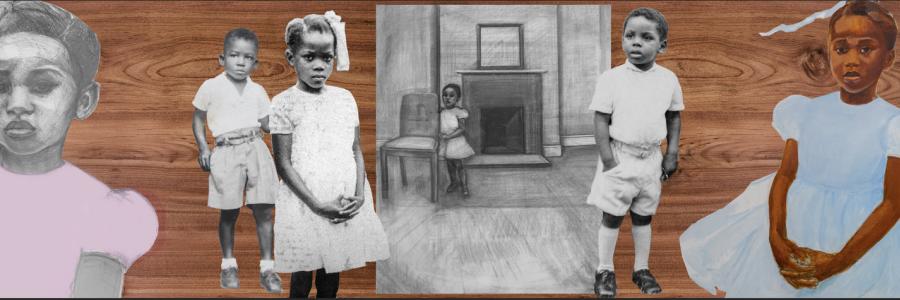
This work is constructed from images created over decades. Photographs taken 50-60 years ago are positioned with studio images against a background of English oak. In the centre is ‘Waiting’, a charcoal painting made 30 years ago. Farthest left, a more recent drawing in graphite is balanced by a newer work, a painting still in progress. The figures represent children whose parents came to Britain from the Caribbean between 1948 and the 1970s. The children might have come with their parents, some would have travelled alone to join parents, and some were born here. I shared a screengrab image of the ‘just finished’ work with poet and mentor Dorothea Smartt who said that she was reminded of the 1986 painting ‘She Ain’t Holding Them Up, She’s Holding On (Some English Rose)’ by Sonia Boyce.
This work does appear to be in conversation with Boyce’s painting and I have titled it ‘Still Holding On’.
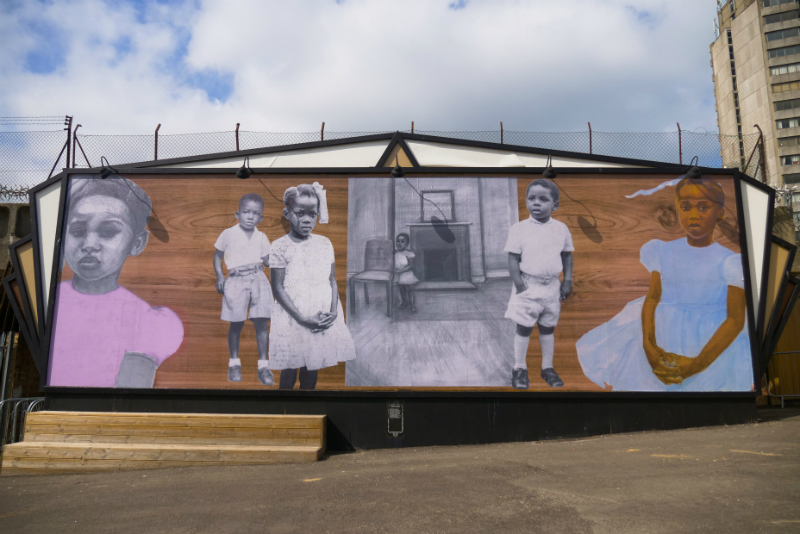
‘Still Holding On’ Mural By the Sea, Dreamland, Margate (Billboard) Valda Jackson 2018
For a brief period, before studying Fine Art in Bristol, I was Administrative Assistant at a Missionary College in Birmingham. I shared my office with one other, a woman in her 50s. By that time, her children were adults, but she had stayed home while they were young. In conversation one afternoon, my colleague said that she will never understand how women like my mother could leave their children, and travel across the world to another country for work. There is nothing, she said, that could have induced her to leave her children behind. Just in my 20s, I had neither experience nor words to argue with this woman, who from her privileged position would never have been called upon to submit to such a choice.
More than 30 years on, and a mother myself, I understand that colleague’s strong feelings. But I also know what it must have taken for my parents, particularly my mother, to leave us behind. I can only try to comprehend my mother’s distress on leaving. I’ve come to understand the hows, the whys of those life-changing decisions. For my mother, in 1960s' Jamaica, there was an absence of choice; but there was hope. There were ambitions for her children; and an impossible dream. So, on a premise, an invitation from the British Government, eventually she came.

Detail: The Artist in front of ‘Still Holding On’ Mural By The Sea
My parents worked. Three years later, my sisters and I joined them here. They stayed and continued to work, supported their children while helping the extended family back home. Personal dreams had to be relinquished. Sacrifices were made. Both my parents laboured. They and many others from the Caribbean joined forces with the workers of Britain, doing the hardest work, heavy industrial work. Tough long hours. And always, they paid their taxes.
Ten years ago, my junior-school child came home one Friday and said that for homework she must interview her parents and grandparents. She had to find out where we all came from and how she came to be born here in Bristol. Her father told her his story; and that he came here to study. Our daughter already knew this.
I told her my story that she already knew. Born in Jamaica, grew up in Birmingham. Came to study in Bristol. And it was here at art college that her father and I met.
Days later, my daughter ran out of her class waving her homework book. “I got two gold stars”, she said. And she could not wait to show me. I checked out the golden stars. And I saw her teacher’s comment written in red underneath:
'How fascinating. Great work. I would like to know under what circumstances your grandparents were invited by the British Government to come and work here.'
I was still wearing my 'well done' smile as I read it. And I didn’t know whether I should howl with laughter, or with tears.
How is it that in such a short space of time, this part of our British history is already forgotten? How is it that a generation who came here and played their part in re-building this country is just ignored?
How has their significant contribution to our society become so hidden that teachers leave our universities, and they don’t know? They teach our children; and they don’t know about the Government’s vigorous recruitment drive in the Caribbean. Why are they not taught about Britain’s desperate plea during the 40s and 50s for workers to come here to help rebuild post-war Britain?
The following day, I mentioned it to a friend who happened to work in the school. I fully expected her to feel, as I did, that some injustice was being done; a valuable piece of our history was being denied.
My white friend defended the teacher. I wanted her to see a wider picture. That this wasn’t at all personal. It wasn’t about one individual experiencing a lapse of memory.
My friend said, 'The teacher was just a young girl. She couldn’t possibly be expected to remember any of this. It all happened before she was born. She’s a lovely girl and she really cares about the children.'
And my friend, to my dismay, was very angry with me. She said, 'It was very naughty of you getting your daughter to write that bit about the British Government. You knew what you were doing Valda; but you wanted to make a point, didn’t you? It’s really embarrassing for the teacher. It was wrong of you. You’ve humiliated the poor girl. And it was unfair of you to use your daughter to make your point.'
Finally, my friend said: 'And to be fair Valda, your daughter wouldn’t have known any of this, if you hadn’t told her.'
Yes, exactly!
My daughter could not have known if I had not told her.
Which is why I had to.
This is a part of our history. It must be told.
Fused Magazine writes about the mural.
Fabuk Magazine writes about the mural.
