


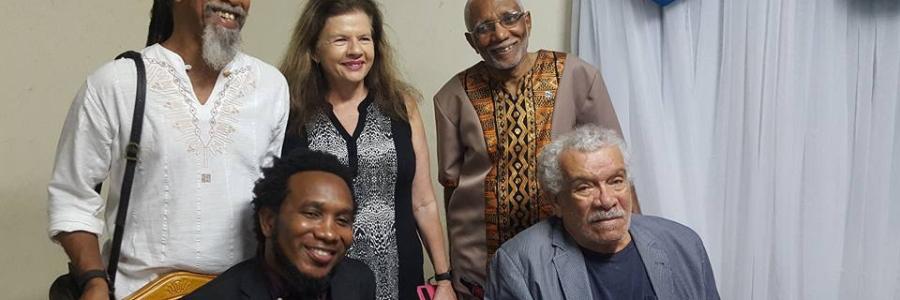
by Vladimir Lucien
I was recently invited to give the annual Independence Lecture in St. Lucia. I was honoured to deliver the talk, entitled "Playin' de Arts": Delinquency, Sovereignty and the St. Lucian Imagination. I am the youngest to have given the lecture, and -- I am told -- it was the first time that the lecture focussed on the arts.
In thinking about what to talk about, I eventually settled on the issue of delinquency and how we have historically defined it in St. Lucia. I wanted to talk about how we have managed the quandary of having our ostensibly most violent communities being also our most creative and original.
This argument is, of course, not new. Earl Lovelace argued the same thing about Trinidad and has depicted it throughout his career in fiction). I, however, wanted to speak to the St. Lucian situation, especially on the heels of a damning report detailing the 'extrajudicial killings' of alleged criminals which took place about 4-5 years ago, in which several persons at various levels in St. Lucian society were said to have been involved.
More particularly, I was interested in the mundane acts of suppression against these communities, and even against our most original cultural expressions, which have deep causal connections to occurrences of seemingly 'random' violence.
Take, for instance, what the St. Lucians call the 'Cathedral Attacks' in which two men stormed a New Year's Eve Mass at the Minor Basilica of the Immaculate Conception in Castries in 2000, lit worshippers on fire and bludgeoned a priest and nun to death.
Two weeks before this, an Egyptian sign of life, the ankh, was drawn on the door of the Cathedral (similar to the apocryphal story of Luther's Ninety-five Theses), much to the bewilderment of St. Lucians.
Or consider the man who, after a late-night mass, jumped onto the bishop at a street corner and put a knife to his throat. These things are no accidents and are not merely explained by broken homes.
I wanted to look at the connections to a history of suppression, and what Erna Brodber calls 'Ancestral Anger' -- the emotion and attitude created by that disconnection with one's ancestors, that dissipation of one's past -- something that can induce certain moods and orientations and produce unimaginable inner turmoil that is eventually externalised. 'Ancestral Anger' is something our analysts, sociologists and politicians must contend with.
I wanted to understand how such acts of seemingly random and extreme violence are connected deep-down to other acts of violence and suppression in our history that we never connect with the acts of violence committed by those we call 'Monsters' or those we need to 'take back our country' from -- beyond the specious explanations of sociologists and psychologists and politicians.
I connected the issue of sovereignty to our ability to shift the paradigm of suppression which remains entrenched in our societies, and to develop more original, sophisticated definitions for delinquency. I argued that such a shift was a key part of claiming our imagination and challenging it.
We need to engage in a process of legitimising ourselves, and what these communities have been trying to tell us we are and are capable of being. In legitimising the vision of these depressed communities, I really don't see how it can be done without considering reparations.
If we do not develop this understanding, we may see terrible, unimaginable things taking place in dis ya Caribbean!
