


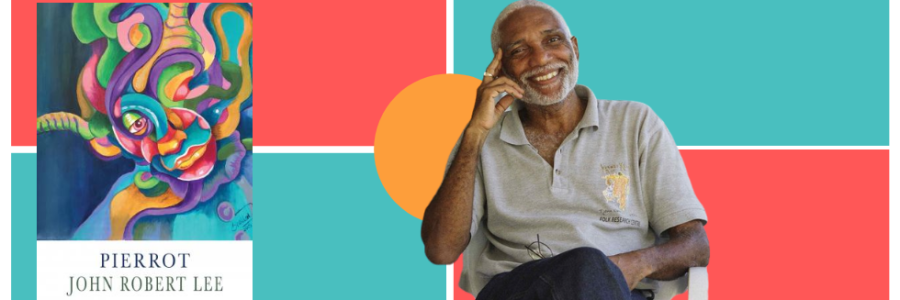
Don’t ask me to remember when I first met John Robert Lee because you’ll send me so deep into the past that I might not come back sane. My mind will start to drift towards a migraine that neither Advil or Aspirin could placate. The answer, when I eventually remember, will come in a dream, the only way it could.
Nevertheless, I recall Robert’s father, Mr Alleyne, operating a drugstore on upper Jeremie Street in one of them CDC buildings that’s no longer there, sandwiched between two rum shops. I liked the smell of the place, a mixture of liquorice, camphor, turpentine and some good old-time medicines that sent you to the toilet before it slipped down your throat and start to work in your stomach. Don’t think I ever caught sight of Robert hanging around the place, but somehow, I knew his father, children always sense these things. I was at the Anglican Primary School when we met. Being four years older I would have appeared much taller and bigger to him; he could have been six but not more than seven and still in infant school. I want to recall this string bean slip of a boy, (like myself) in catalogue blue short pants matching his younger brother, walking slowly past the ‘Top School steps’— two lost souls in search of Purgatory—on their way down hill towards Chaussee Road where the infant school was then. For some reason I thought like his cousin who sang in the choir he was an Anglican although I never saw him in church. The Lees’ lived on parish lands and in those days no priest worth his salt would let you remain on church lands if you were not part of his congregation, particularly the canon who was the rector then and breathed fire and brimstone without need of provocation.
I had cause once or twice to pass through the yard where Robert lived. It was a kind of short cut from George the fifth park, called The Gardens for short, when you did not want to be caught by the headmaster for missing the bell at end of recess. I had been caught at least twice, and got licks once for pelting stones in the mangosteen tree near the western entrance to the Park. Sounds from the school yard were blocked by tall trees all around and did not travel to that far end. While I escaped the headmaster’s wrath on other occasions, thanks to Robert’s great aunt who preferred to report me to my mother instead, and I don’t have to say more. The rest of this part of the story has no place here.
Memory plays tricks on me nowadays, but it would be safe to mention I lost sight of Robert after I went to secondary school and did not meet him again until I was in form four at St. Mary’s College. Lunch time under one of the two back steps, facing the raised mound of a large underground cistern, where I held court. By then I was already an avid reader gobbling up everything I could lay hands on at the Central Library. My mother could not afford to buy books, so she enrolled me from ten in the junior section and gave me a standing authorization at twelve to order books in her name upstairs, in the adult section. I became fascinated with stories from World Wars One and Two along with other interesting battles I came across in historical texts. I transcribed some of these stories into my exercise book making editorial changes along the way to hold the interest of my peers. Robert formed part of my captive audience. For a whole year the boys came daily to follow the war stories and to purchase my bread and corned beef fare in gratitude for the free entertainment. Robert asked lots of questions to which I did not have the answers at my fingertips. Bluffing was out of the question, these boys were sharp and in addition to my school homework, I was forced to study all the important campaigns, the names of generals, weaponry and place names where the battles were fought.
I retired the following year when I went to fifth form, because I could not cope with this overwhelming thirst for knowledge that seemed unquenchable. I allowed the boys to invest in their studies while I plodded on with mine. It was going to be my final year in school and could not afford to fail my exams for without that coveted piece of paper in my hand no job would be coming my way. I lost sight of Robert again, my final year was spent in and out of libraries (school and public), until November when I succumbed to the invigilator’s clock and gavel.
In 1968/69, thereabouts, Robert re-appeared, he landed a job at Royal Bank, and we worked alongside each other, I was by then a senior teller. We developed a habit on Fridays and paydays ganging up after work at Gaiety’s, Calabash, or Rain, (all restaurants) for Bentley’s and hamburgers. We were not yet imbibers of the hard stuff. Some of our other friends managed a beer or two, but disappeared from the scene ahead of us, before it went to their heads. Very few of the girls followed us in those days, fearful of the ire of parents, relatives or neighbours. On my meager salary I had already purchased a Hermes typewriter and a Pentax camera equipping myself for the mission ahead.
This was the period when I really began to get to know Robert and discovered like me, he was an avid reader with a penchant for the best, modeling our fledgling stuff after varying styles that struck our fancy. Since I had been working a bit longer than him, I had already acquired a selective assortment of books by pioneers of a new literature, loosely called West Indian, perhaps after the regional cricket team that was making inroads on the world stage, because there was no place I knew on the map by that name. The period was after the decline of Federation, Jamaica, Trinidad &Tobago, Guyana and Barbados had severed anchor chains with Mother Country and we the smaller islands were left rudderless, afloat on a sea of change.
The Voice bookshop in keeping with the times apparently through the influence of Sir Garnet Gordon, proprietor and one-time High Commissioner to the United Kingdom, went out of its way to procure the works of West Indian writers from English publishers with a new book and a new author featured every month, in time for payday. My collection, there was: Walcott, St. Omer, Brathwaite, Lamming, Mais, Hearne, Harris, Mittelholzer, along with a subscription to CQ and Bim Magazine. I got Robert acquainted to Miss Riley, the Voice bookshop manager, who diligently put aside new arrivals for us. I was already a member of the Saint Lucia Arts Guild and Robert became familiar with Roddy, Derek Walcott’s twin and started hanging out with the Guild crowd, an interest in theatre was born. As a teenager, I was inherently shy, but displayed a kind of bravado to mask it. I had been writing mainly poetry and short stories for some time but had not done anything apart from showing it to a few close friends. I also painted in oils and water colours. Robert confided in me that he too had been thinking about writing seriously and left two short poems for me to read over a weekend. “If you don’t like them, don’t tell me,” and disappeared grinning from ear to ear.
I took the poems home and read them. I don’t recall the subject matter but I was pleased. We spoke about writers we had stumbled upon on the library shelves and in the book stores, (remember there was no internet then) and we exchanged views—a weird compendium of likes and dislikes sometimes bordering on the esoteric. For example, we read Children of Sisyphus by Orlando Patterson and discussed the novel’s strengths and weaknesses with such gusto that an eavesdropper would think we had lived in Jamaica and had met our first Rastafarian Bredren.
It was about that time I also discovered Mailer and Vidal in addition to Maugham, Hemingway, Arthur Miller, and Nevil Shute. Robert on the other hand was generously conservative and stuck to Eliot, some Tennyson and the Bloomsbury poets. We were however intoxicated by the sounds of Dylan Thomas, and were beginning to synchronize our humble offerings with the poetry of place using Walcott’s ‘In a Green Night’ as if it were the New Testament. However, for me it was the prose of D.H. Lawrence to which I often returned, there was a quaintness in the voice of Mellors the gardener, in Lady Chatterley’s Lover, which reminded of the language of the ordinary people— the voices I heard at home and in the yard. I had read the book as a juvenile, borrowed under the guise of my mother’s authorization after having heard it was banned. I do not know if it was during that period Robert developed an interest in Library studies, (he was usually quite secretive about such things) but we combed the shelves, particularly on Saturdays in search of gems for our weekend read and usually found them. We also developed the habit of going to the beach on Sunday afternoons to practice the art of reading poetry aloud, listening, tightening our drafts and correcting each other. We were schoolboys again, with schoolboy zeal, tuning our lines in the absence of an errant master, exploring language — as we heard spoken in offices, banks and church, alongside the more colourful euphemisms from the marketplace, rum shop and street.
There was a rich verve rising with hot air from the bars on Jeremie Street and on the little back roads around town. Vernacular rolls like shaving from a carpenter’s plane from the tongues of banana carriers on those long lines from depot to ship at the wharf; it was as musical as it was comical, ribald, matching Rabelais. The tiny hovels that speckled the borders around Castries carried their own quaint whispers with the advent of night and an army of fireflies. We noted the richness and colour of things around us absorbing formal and informal with equal specificity, each steeped in their own tisanes to provide distinctive tastes. We drank separately from the same cups and in different spheres. I was a frequent visitor to the country; my father was a planter who owned a small estate at Ti Colon, a stone’s throw from the Cul-de-sac valley heading south. I learnt Kréyòl at home but became au fait with the language conversing with estate workers. Robert was the opposite; he was at heart a town boy who only began to explore the Saint Lucian countryside as a young adult. He struggled with the language, always asking the meaning of this or that, but he possessed an inquisitive mind which would eventually become his saviour. We decided after devouring samples provided by Derek and Roddy; after reading Garth’s ‘Room on the Hill’ and walking the streets to imagine how they would have looked twenty-one years before, before and after the great fire of 1948 that devoured the bottom half of our town, we knew there was no turning back. Unashamedly we went about our mission with frequent incursions into the countryside not too far from Castries but far enough to observe differences in the way of life between town and rural habitat. We were not intimidated by the common tongue, which everybody knew but only a few dared to speak in public. Place names, faces, customs and practices strolled into our work with the same ease with which we rattled Shakespeare off the tip of our tongues. Like soldier crabs we welded a thick carapace to our backs anticipating an onslaught of negative criticisms, personal or otherwise from part time custodians of the English tongue stemming from the mixed language in our work. It was an age when hypocrisy was rife. (maybe that’s still the case) Kréyòl was unpopular among the classless populace who preferred to remain British subjects although they could barely frame simple sentences in the borrowed language of the colonizer. They were not prepared to tempt fate and accept the meaningful existence of independent citizens of a free world, with a mother tongue that was unique in embracing all the colonial languages spoken in the hemisphere though tainted by none. Parents strictly forbid their children to speak in Kréyòl because they believed it would retard their future progress; they swore speaking it would destroy a child’s fledgling vocabulary, forcing a “country bookie accident” to manifest in the process; school principals rigourously enforced the law. Even court interpreters took advantage of prevailing conditions and translated as they pleased for foreign magistrates to the amusement of packed courtrooms, especially on Monday mornings, congregated for nothing else but the coarse humour flowing freely from case to case.
It was also about this time that Patrick Anthony Butcher entered our circle which also included Stanley Reid, a teacher and writer who edited Link magazine. How PAB morphed into PABA I will never know, but he must be counted as one of those restless spirits who toiled with us on that long journey towards realization of our many talents. He was committed to becoming a priest and enrolled at the Seminary, Mount St. Benedict, in Trinidad. We corresponded and met every August and Christmas time when he visited. We saw ourselves as the generation after the Walcott Brothers, Leo Spar St. Helene, Garth and Dunstan St. Omer, (not brothers) willing to remove metaphorically every statue from its pedestal in the church and proclaim a new heresy. However, the social order never allowed us to express ourselves beyond the confines of our work or to gamble our futures on becoming outcasts among our own for preaching the new schism. Heavens be praised, along came the heady seventies and with them Vatican II, which gave every man the right to praise his God according to his calling, in his own language, with his own vision, though not in Neanderthal parameters where issues with complexion and therefore race, which by extension meant inequality and bred division were common denominators. Dunstan St. Omer led the charge for our emancipation with his altarpiece at Jacmel, forcibly bringing home the unacceptable truth to minds that doubted its fallacy but were not strong enough to voice their objections. His Madonna and child basking in an evening sun over banana fields in Roseau valley will forever remain for us a heroic symbol of our freedom of faith and a summation of our youthful thoughts that we were yet to translate into words.
“Two earth brown labourers
dance the botay in it, the drums sounds under
the earth, the heavy foot…
Nobody can see it and it is there,
nobody adores the two who could be Eve and Adam dancing.”
Walcott, Saint Lucie V. from Sea Grapes.
PABA returns as a priest and continues from where he left off, but with added trappings laced to his soutane—charged with more than an ordinary desire to bring the church to his people in their language with all the baggage, practices and beliefs. Robert would also return from University and publish his first collection of poems, Vocation in1975, it was not ironic to find the title poem dedicated to a certain Fr. Patrick Anthony.
“And I
who share a common celibacy
that priests and poets must endure,
search that purity of syllable
seeking truths you’ve found;”
JRL, Vocation.
When we embarked on our separate journeys, each with that one vocation in mind, to educate ourselves in order to extricate our people from a poverty in the mind that used the shackles of colonialism like a badge to harness them in perpetual servitude as charcoal burners and coal carriers in a world that had long left this country behind lost in another century. We did not know that our paths would cross and crisscross though separate pilgrims each on his pilgrimage towards the same horizon: banker, priest and poet, the weight of humanity on our backs, our hearts striving for that proverbial light that would come with the gift of wisdom when all eyes open we see the truth as the elusive scoundrel it is on the lips of believers who do not necessarily hold the same beliefs as us.
To my friend Robert, in your 75th year, I will not postulate on common fallacies, like wishing you long life, prosperity and happiness. If you have not already excelled at all three, it may be too strenuous to try at this late date. I would ask however that you remain faithful to your craft while enjoying that one true miracle from the creator’s hand—the gift of manipulating the written word into poetry. Let me end in your own words as images of our younger years float by—
“My plot of ground is dry and hard
as sidewalks are; at nights street lamps
block out the stars and hi-fi sets
replace the country violins;
and I must dig foundations deep,
plunge steel and concrete shafts into
this city’s dirt, and hope for structures firm,
and spare, no space for flair or show,
each entrance, passage, exit, clear and marked,
each section storing much within a little space.”
JRL, Lusca.
© Mac Donald Dixon 2023. All Rights Reserved


