


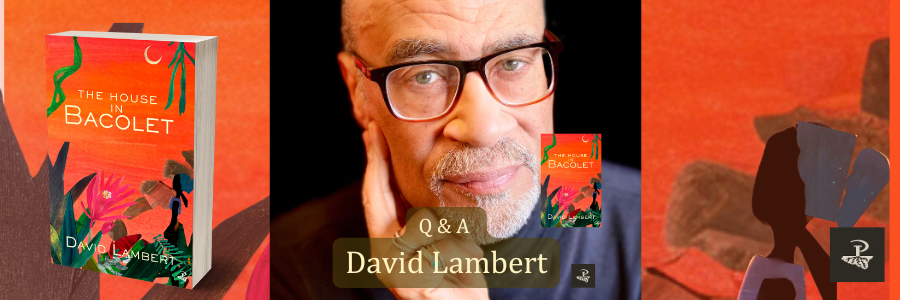
Author interview with David Lambert
What was the first image, moment, or line that sparked The House in Bacolet?
The staircase is now all that remains of the old house which stood in Bacolet Tobago. I remember as a child playing marbles and jacks on their tiled surface when the old house still stood there. So it was a shock when I revisited the island 32 odd years later to find the house vanished, and the staircase still standing in the middle of an empty field with the sea glittering in the distance through its archway. It’s the sight which intrigues the Penningtons when they drive past it on their first visit to the island. Was it built as the folly of some 18th century planter. They walk up to its top, then down the other side, none the wiser. Of course, I’ve reimagined the original rather prosaic flight of steps and turned it into a sweeping curved stone staircase with a crumbling classical balustrade. I’m still working out what it signifies: the passage of time? The futility of man’s projects? In this sense, it may be an iteration of the Ozymandius poem Leonora recites, with its description of the two vast and trunkless legs of a past tyrant lying forgotten in the desert sands. Certainly, the old Dutch tiles which have vanished from the top, and Hugh’s finding them, suggests the possibility of restitution of what’s been lost. Derek Walcott refers to ‘this shipwreck of fragments, these shards… The gathering of broken pieces which I use as the novel’s epigraph. In the return of artefacts lie possibilities for the restitution of the human diaspora too.
The actual idea of a British couple buying up an old church and coming to live on the island was seeded by a German sculptor friend, Luise Kimme. She’d lived on the island for many years. She told her guests over Sunday rum in her studio, about a local guy (called Elvis!) with an unregistered taxi who had picked up a Swiss couple at the airport when their estate agent failed to show. Elvis ‘took advantage’ of the newcomers and ‘totally got into their lives.’ Once he’d moved in with them, you couldn’t tell who was boss and who employee. It was their ‘white guilt’, she said, that let him walk over them. So I wanted to explore that theme and to show how context (living as Europeans on a former slave plantation), despite the characters’ best efforts, ultimately determines their relationships.
What drew you to set The House in Bacolet in Tobago, and what does the island mean to you personally?
I was born in next-door Trinidad but we spent all our holidays and my last year in the West Indies, age six, in tiny Tobago. That formative year was when I was stamped with my most indelible impressions: being read Alice in Wonderland, my parents’ reaction to the assassination of JFK, discovering on our land the old coconut grenades used in the filming of Swiss Family Robinson (the Disney corporation used ‘Reith House’ as its headquarters). I was intrigued by the reality of the burnt coconuts I could actually hold, and which I’d seen lobbed at invading pirates in a movie. And of course there was ‘Flora’, the hurricane which struck, and which crops up, an elemental determining force, almost a character, in the novel. In setting the novel in the place of my childhood, I was reawakened to the rich poetry of island speech, the cadences and intonations of the locals (an accent I myself first spoke with) and which dictated the dialogues and therefore the storyline. It was of great importance to me to render accurately the various degrees of Creole speech in Leonora Williams, Ramkissoon-Singh, Horatio and Riva, so my readers might hear its beauty in their heads as they read.
Tobago is a precious tiny island, with unique traditions and talented people, punching well above its weight for beauty. It’s really my childhood idyll which is threatened by destruction, and which I naturally want to preserve. It’s a kind of repetition of the piracy of old which, historically, all the islands fell prey to. Only this time it’s the depredations of corporate food and hotel brands, shopping malls and the threat of mass tourism. I guess it’s Walcott’s ‘gathering of broken pieces’ again. I’ve unashamedly employed the services of the doughty Leonora Williams to speak for the preservation, indeed the restitution of all that is real and peculiar to the island.
The novel is full of quiet tension and unspoken emotion. How do you approach writing silence and subtext?
This is in many ways the portrait of a marriage, one transplanted to a new and challenging environment. In order to preserve the, at times, brittle peace, Hugh and Julia are adept at knowing when not to express their emotions with each other. This natural propensity for bottling things up helped me create a tension between them, especially in the dialogues where I could use interior monologue to show the discrepancy between what’s said and what remains unvoiced. It’s at the heart of the growing misunderstandings between them. No wonder Hugh revels in the simplicity of communication with Friday the dog. (‘It had none of the snags and reefs of human communication.’)
As tricky, for very different reasons, are conversations with locals. Here, the context of past slavery and more recent colonisation problematizes exchanges. Hugh and Julia are wary of giving offence. In an early scene where Julia finds herself discussing art and colour with Horatio their driver, she’s desperate to avoid condescension (he might know Van Gogh, but Raphael?) –– until Horatio gives her a lesson in ways of seeing Caribbean reality. In an effort to get closer to Riva (the ‘maid’), Julia decides to ask her about a local dish she’s preparing. But it’s like getting blood from stone, and she feels ‘vaguely deceitful for having engineered the situation.’
It's been pointed out that almost all of my writing starts ‘abroad’, in some place alien to the protagonist. Or at least in an airport or train station on the way there! As a reader, I always find there’s a bonus in a novel which whisks me away to an entirely new place. No need to make travel plans, book tickets, hotels ... In The House in Bacolet I wanted to ‘give’ my readers Tobago. I’d hate to think of them skimming (!) the descriptions of the island’s luxuriant nature to get to the ‘story’. The descriptive passages are central to evoking the strange, dislocating effect Tobago has on the Penningtons, charting the journey of this well-intentioned British couple towards fuller, less restrained expression. ‘We have to talk, is no good to bottle it aall inside!’ Horatio tells Julia. A disinhibited Julia finds herself opening up about her and Hugh’s past. Was that just a thought in her head, or had she actually said it out loud? But with the loss of inhibition comes indiscretion, and it is this that feeds incident and drives the story forward to a surprise ending.
If readers take away one feeling or question from the book, what would you hope it is?
I intend the novel to engage with two sensibilities, the British and the Tobagonian. I believe my dual Irish-Caribbean heritage makes me well-placed to excavate both the local and the newcomers’ points of view. But besides the excerpts from the recollections of a nineteenth century house slave, I’ve deliberately chosen not to write from any of the local characters’ points of view. A little controversially perhaps, we’re getting the ‘white gaze’ (again), the narrative remaining resolutely from the point of view of Hugh and Julia (with a few chapters from the viewpoint of their daughter Letty). They are bewildered by differing understandings of what, say, having a dog or a home-help might entail. It is in their desperate attempts to negotiate meaning with the local characters that incident is largely fueled, and where I feel the novel’s drama resides.
The intention here is also to upend ready-made assumptions about Caribbean reality. Must its beaches always be represented as palm-fringed, the colours represented as primary or vibrant, its people either exuberant or indolent? As unlikely as it may seem, it is Horatio who speaks back to this view, evoking to artist Julia the nuances she overlooks: ‘It have gentle sunrise, pink misty-up mornin’s like a pale pale rosé wine that make yuh feel to weep an' yuh ent know why. We have subtle too, man!’
We may not get inside Horatio’s head but what he says in the dialogues and (some of) his behaviour challenges at least some received ideas. It’s worth saying that these assumptions about the West Indies are not only made by ‘people from away’ but often perpetuated by West Indians ourselves, in writing, music, the visual arts. Is our cultural output forever destined to come under the rubrique ‘carnivalesque’...?
