From the translators and editors of the anthology of Caribbean women poets
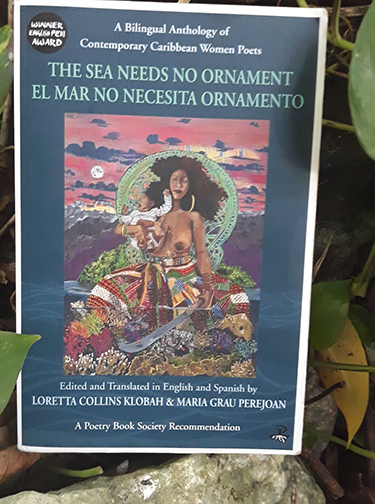
The Sea Needs No Ornament/El mar no necesita ornamento
Loretta Collins Klobah and Maria Grau Perejoan
The first thing that came to mind when we were invited to write this blog on Women in Translation Month was our initial idea to do translations and edit the anthology The Sea Needs No Ornament/ El mar no necesita ornamento as a way of promoting Caribbean multilingualism and increasing readership for women writers within the region, the Caribbean Diaspora(s), and internationally. When we began the project (during the month of Hurricane Maria’s landfall), we looked at the strongest writing by thirty-three of the Caribbean women writers who (for the most part) had started publishing in the 21st century. Our main excitement, in truth, though, has been in the connections that the women writers were able to make once the book came out. When we think about Women in Translation Month now, we remember the kind of meaningful conversations that the women had with each other about the anthology itself, the translations, and each other’s writing.
All of the poets were involved in the translation process. Each of them saw drafts, gave suggestions, and helped us with our doubts. Moreover, when the book debuted, online gatherings were organized that brought together writers from the Spanish-speaking and English-speaking Caribbean so that they could get to know each other, read each other’s work in translation, and have conversations. We had the hope that those introductions might in the future lead to literary friendships.
We were so lucky to be invited to launch the anthology as part of the Bocas Lit Fest in Trinidad and Tobago. Other online venues where various writers were brought together included the Association of Caribbean Women Writers Conference in Jamaica, a session titled Cross-currents in Contemporary Caribbean Poetry in Spain, and the Jornadas del Libro Caribeño in Mexico.
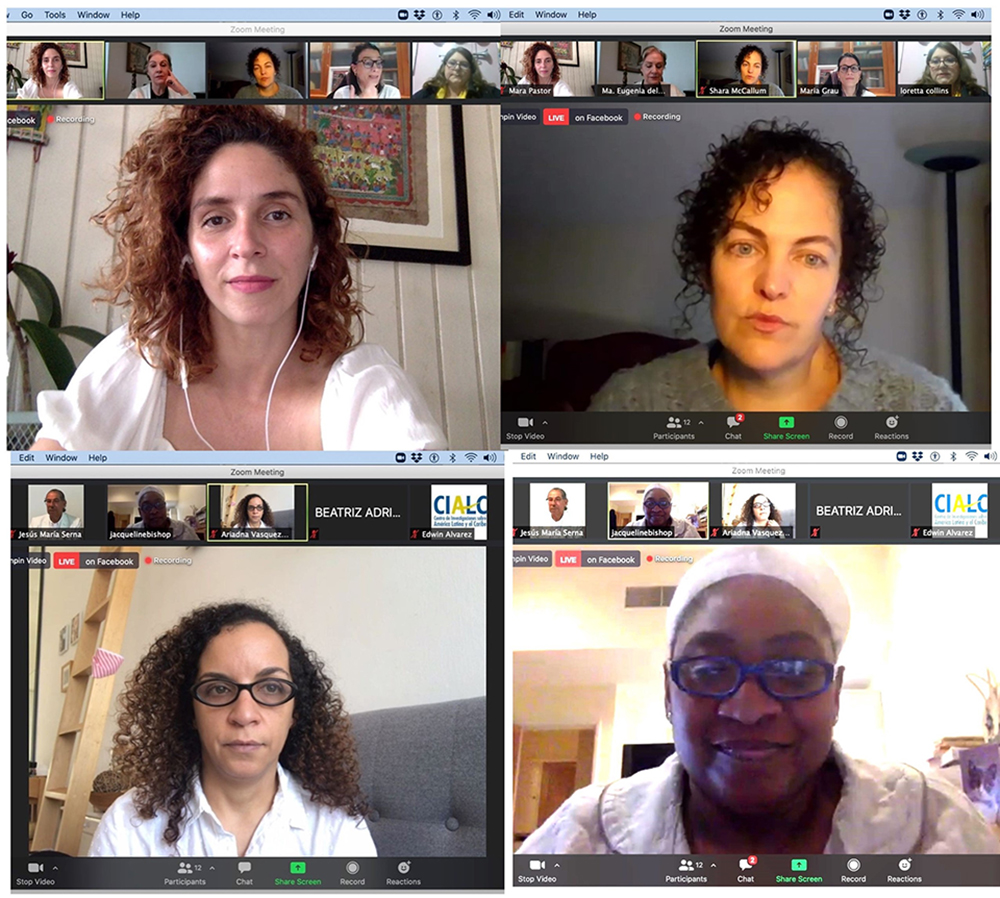
The women writers who presented a bilingual reading of their poems and spoke with each other in the Jornadas del Libro Caribeño hit on what we also think were some of the most valuable aspects of this translation project. Jacqueline Bishop (Jamaica-US), Shara McCallum (Jamaica-US), Mara Pastor, (Puerto Rico), and Ariadna Vásquez Germán (Dominican Republic-Mexico) found commonalities in their writings and lives, mentioning that reading their Caribbean sistren opened up conversations with other women close to them.
Mara Pastor remarked that reading the collection made her aware of how few of her literary women contemporaries she knew about in the Anglophone Caribbean. Shara McCallum’s poem “What I’m Telling You/ Lo que te cuento” about being a child and seeing Bob Marley in the recording studio where her musician father also recorded brought back reggae-loving memories to Mara.
As she said:
I wanted to comment on something related to Shara’s poem. In a somewhat anecdotal manner. One of the things that was most shocking to me about this anthology is the intersecting points, but also the little I, myself, knew about my Caribbean sistren and Caribbean women poets. I was so surprised to see that one of my intersecting points with Shara’s poem is precisely music, reggae. How the notion of an Antillean Confederation often is transmitted through music first. And here in my home, in Puerto Rico, reggae was what first introduced me to Jamaica. As a teenager, I would go to concerts of Black Uhuru, The Abyssinians, and Israel Vibration – my favourite reggae band at the time. And the anecdote with Bob Marley really moved me, as well as the nostalgia of the girl at that beautiful moment with a world-class personality (translated by Loretta Collins Klobah and Maria Grau Perejoan).
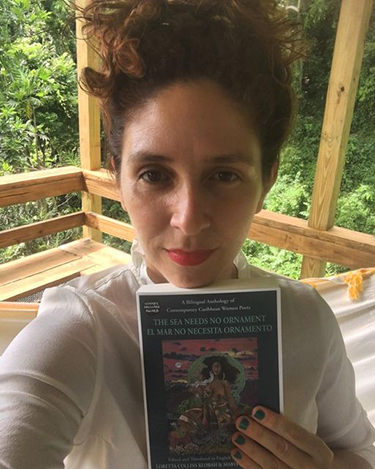
Mara and Shara connected with each other through music and their poems about memories of their fathers.
Jacqueline, Shara, Mara, and Ariadna all talked about the power of the poetry brought together in The Sea Needs No Ornament/ El mar no necesita ornamento. All the individual collections that the anthology’s selections come from include frank and risk-taking poems both thematically and stylistically. Many cultural, historical, political and social concerns of the Caribbean were covered in poems selected for our book, but there were also many formidable, forthright poems that are particular to the experiences of those who identify as women.
In the Jornadas del Libro Caribeño, Ariadna commented on the impact of these topics. She liked the book’s many poetic styles in a gathering of brave and strong voices. After the bilingual reading of Jacqueline’s ‘Snakes/Serpientes’ (on sexual abuse of a girl child), Ariadna said that many of the poems in the anthology, like Jacqueline’s, shared ‘una rudeza vital’ (a vital rudeness). This ‘rudeness’ is a poetic force for social intervention and critique in the poets’ own books, which, in a way, gets amplified by bringing together poems by the thirty-three powerhouse women writers in our bilingual anthology.
Jacqueline had this to say about the dialogues between the writers and the content of the book:
I know there’s a lot of pushback on the notion of a safe space, and people who talk about ‘safe space’ are supposed to be flakes. What’s the term now? Snowflakes, we are snowflakes. But I see the anthology as providing a safe space for unsafe issues at times. For women to talk about things that are difficult to talk about…and uncomfortable and a taboo to talk about.
As translators we looked for writing by contemporary Caribbean women that was fierce, fresh, incisive, inventive, humorous, thought-provoking, and tender. We loved to hear comments like Shara’s about Mara’s poem ‘Jeep Cherokee’:
When I was reading your poem, Mara, I loved so much the deceptive simplicity of the language of the poem…I agree that these poems are not always ornamented, to use that word, but I think there’s still so many depths and layers, and this is one for me that really begged repeating. I also heard humour in it, and a very tender relationship between the father and the daughter, complicated but also tenderness there. And yes, I agree with everything, Jacqueline, you said about the book’s themes, they are often difficult, but I found this poem to be a bit of a respite. So, there’s a certain sadness to it but also a lot of compassion and tenderness that I really appreciated in it.
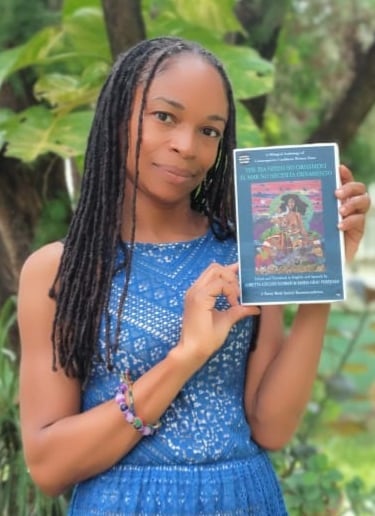
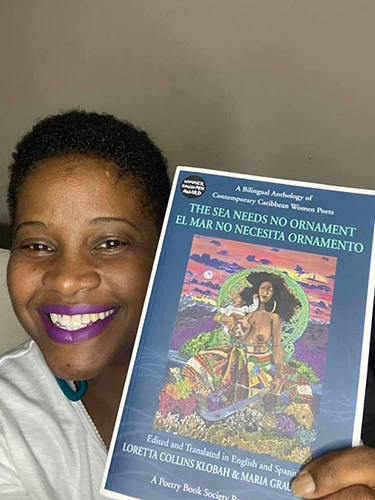
We expect the anthology to be read in this vein, as a good book that does showcase Spanish and English versions of seventy-one poems (three-five poems per author) by many of the best contemporary Caribbean women poets. Glad and very grateful to say, a multi-award-winning book. But more than this, we’d like readers to see our collaborative work of thirty-three women, two translators, the fabulous cover artist Damaris Cruz, and her model for the artwork, actress María la Cotto as shared work conceived of from the beginning to bridge language divides between writers, themselves, and between them and their readers. The project has gone beyond the pages of a book, to bring some of the women writers together in literary sisterhood.
In our Caribbean and its diaspora(s), a plurilingual region, points of connection though translation work have a role to play in forming a more ample and integrated Caribbean writing community where authors can cross linguistic lines in mutual support of each other as we continue to address history while also facing the future troubled times regionally and globally that we already see the signs of now. A cultural ideal of an artistic ‘confederación antillana’, as Mara Pastor has called it.
We are glad to celebrate Women in Translation Month with Peepal Tree Press, whose team has done so much to facilitate The Sea Needs No Ornament/ El mar no necesita ornamento and advise us on possible future translation work.
We’d like to thank the writers included in the anthology for collaborating in this project: It has been a terrific honour and challenge for us to collaborate with and translate the work of these crucial writers, who undoubtedly will continue to publish and be leading literary voices in the decades to come: Gloriann Sacha Antonetty Lebrón, Marion Bethel, Jacqueline Bishop, Danielle Boodoo-Fortuné, Malika Booker, Vahni Capildeo, Nicole Cecilia Delgado, Thaís Espaillat, Sonia Farmer, Gelsys García Lorenzo, Millicent A. A. Graham, Zulema Gutiérrez Lozano, Khadijah Ibrahiim, Yaissa Jiménez, Cindy Jiménez-Vera, Ann-Margaret Lim, Hannah Lowe, Canisia Lubrin, Shara McCallum, Jamila Medina Ríos, Monica Minott, Mara Pastor, Esther Phillips, Jennifer Rahim, Shivanee Ramlochan, Legna Rodríguez Iglesias, Tanya Shirley, Safiya Sinclair, Dorothea Smartt, Karol Starocean, Ariadna Vásquez Germán, Donna Aza Weir-Soley, and Tiphanie Yanique.
We want to acknowledge that women writers and activists the world over have played and continue to play a strong, protagonising role in literary arts, culture, and social change. That’s why we hope everyone will read women writers transnationally and in translation.
We leave you with videos of two of the writers included in the anthology. Cuban poet Jamila Medina Ríos reads her poem “Huerto” in Spanish, and Jamaican poet Ann-Margaret Lim reads her poem “On Reading Thistlewood’s Diary, part III” in English.